Five loaves, two fish and a playground: coming home to Holy Spirit
By Garth Lategan
I went to the Holy Spirit Community Fete on Saturday with a camera around my neck and a job to do. Official photographer. Media. Giving live commentary as I went. And after thirty years of running events, I can’t walk onto a site without noticing where the bins are, how people are getting in, and who’s doing the heavy lifting.
But somewhere between the cake stall and the oval, the job gave way to something else. I was home. I was home.
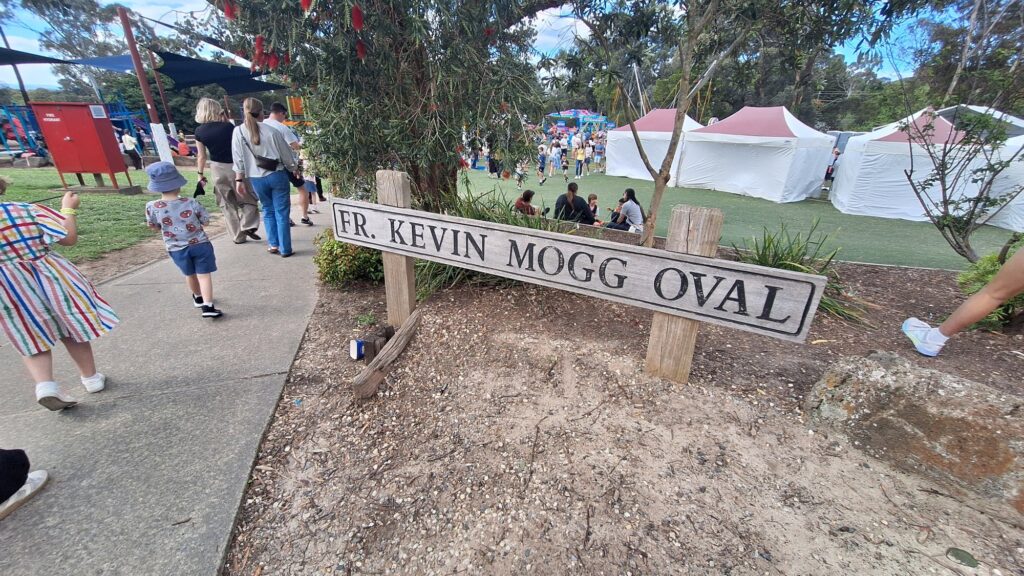
Holy Spirit was the parish of my childhood. And there, beside the path into the fete, was a timber sign: Fr. Kevin Mogg Oval. Father Mogg was our priest. Seeing his name on that sign, with families wandering past it towards the rides and the tents, pulled me up short. The priest from my childhood Sundays now has an oval named after him, where kids run around on a fete day. How does that happen? Well, I suppose that’s what years do.
Sundays, and the toilet
Later I walked to the church entrance, and without thinking I dipped my hand in the holy water and made the sign of the cross. Without thinking. Some things your body remembers long after your head has moved on.
And the memories came with it. Sunday mornings, Mum yelling at us kids to get out of bed for church. Did I understand what it was all about? Not really. I’d sit through it, and on a good week I’d slip off to the toilet and have a doze. Looking back, my attention was well and truly elsewhere. And I doubt I was the only one.
When our family’s circumstances changed, we stopped going. And like a lot of people, I drifted. Life got busy, I travelled, and church became something from childhood rather than something in my life.
Many faiths, one lesson
Travelling the world, I met people of many cultures, religions and belief systems. And what struck me wasn’t how different they were. It was how much of it came back to the same question: how do we live together? How do we look after each other?
So now that I’m older, that’s how I’ve come to read the Bible’s stories. Not so much as rules handed down from on high, but as lessons in living together as a community. The cross itself, to me, is a motif of sacrifice for the greater good. You give something up so that others can have more.
The loaves and the fishes
Standing in the middle of that fete, one story kept coming back to me: the feeding of the five thousand.
You know the one. A huge crowd has gathered, everyone’s hungry, and there isn’t nearly enough. In John’s telling of it, a boy offers what he has: five barley loaves and two small fish. That’s nothing, really, against a crowd that size. But it’s offered, it’s shared, and somehow there’s enough for everyone. And then comes the bit I’d forgotten as a kid. The leftovers are gathered up so that nothing is wasted, and they fill twelve baskets.
Why that story and not another one? Because it’s what I watched happen on Saturday, almost literally. A fete is a multitude that needs feeding, and it gets fed by hundreds of small offerings. A tray of slices from someone’s kitchen. A box of books from a garage clean-out. A bag of soft toys the kids have grown out of. A local business that can’t give cash, so it donates a voucher or a service instead. A few hours behind the sausage sizzle. On its own, none of those builds a playground. Together? They do.
And guess what? Even the leftovers get gathered up. The unsold books go on to other fetes and charities. The leftover toys are stored for next year or passed on. Nothing wasted. Twelve baskets.
There’s one more thing in that story that stayed with me. It was a child who made the first offering. And the playground this fete is funding was designed with the students. Built for and by them, as the school put it.
Sacrifice, taught by action
So what did I actually see on Saturday? Sacrifice, in the old-fashioned and best sense of the word. Not grand gestures. Volunteers giving up a sunny Saturday, and the weeks before it, for kids and a playground. The kitchen crew at the Devonshire tea cafe cooking, serving and cleaning all day to feed the masses. The volunteers at the toy stall, tired by mid-afternoon and still serving. One of the main organisers wheeling a waste bin through the crowd. No job too small, no job too great.
There’s a responsibility in that, too. Doing what you say you’ll do is what makes you reliable, someone people can count on. Every one of those volunteers said “yes, I’ll do a shift,” and then turned up and did it. Turned up and did it.
And that’s how values get passed on. Not by preaching, but by action. Kids learn far more from watching Mum run the cake stall than they ever did from me half-asleep in the church toilet. And when the community benefits, everyone benefits in return.
Now, we live in a culture of instant gratification. Tap a screen and it arrives. A fete is the opposite. Months of planning, early starts, sore feet, and a payoff you might not see for years. Most of the people who baked and sorted and sold on Saturday won’t have kids climbing that new playground. Some of them never will. That’s delayed gratification: some pain now for a greater result that benefits more people. And I think it’s a lesson we could all do with relearning. I know I could.
My own view, and it is just my view, is that a lot of what the West has built rests on these Christian values: sacrifice, service, looking after your neighbour. Maybe you see it differently, and that’s fine. I’ve met people of other faiths who live those values every bit as well, and I’m not saying they belong to anyone. But I saw them on display in Ringwood North on Saturday, in the grounds of the church I grew up in, and it moved me more than I expected.
Back through the door
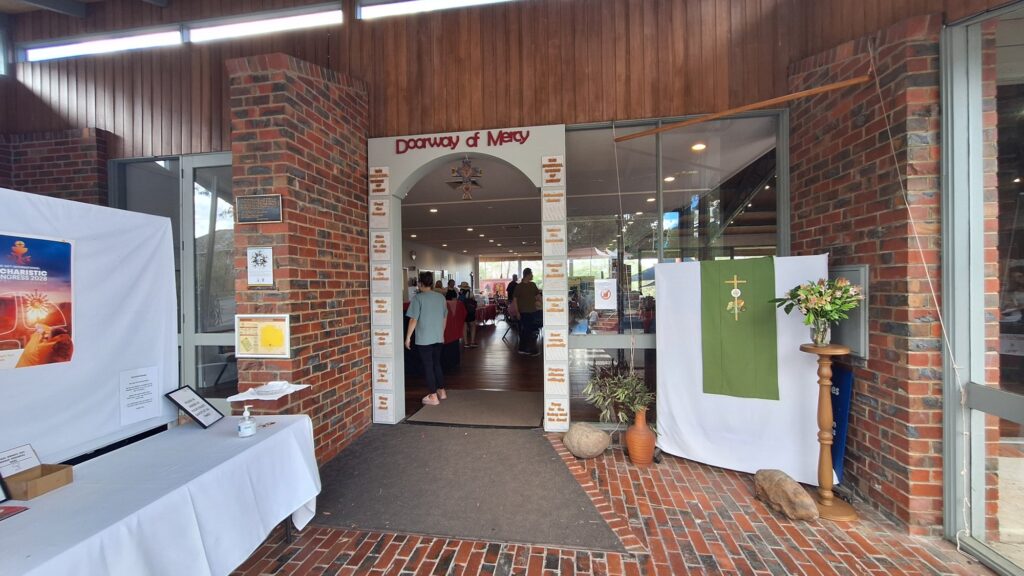
The church entrance has a name now: the Doorway of Mercy. On Saturday it stood open, with a green altar cloth and a simple cross beside it, flowers on a stand, and fete-goers wandering in and out.
I walked out through it a bit differently than I’d walked in. Did I come back to church on Saturday? Not really, no. But I came back to a community, and to the values it was quietly teaching all day by simply getting on with it.
Five loaves, two fish, a lot of volunteers. And a playground for years.